Breville Dual Boiler (BES920) review
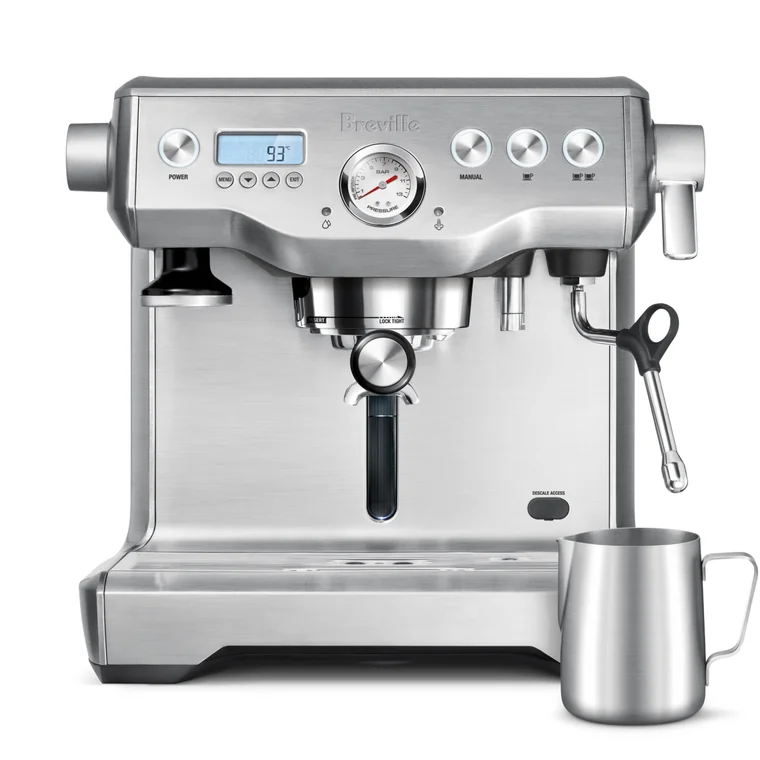
Cafe-style control at home. Two boilers let you pull and steam at the same time, the 58mm commercial portafilter opens up a world of accessories, and the PID holds temperature steady. No grinder, so budget a good one on top.
Check price at Breville →- Dual boilers, brew and steam together
- 58mm commercial portafilter
- Rock-steady PID temperature
- Strong, fast steam
- Feels like a real cafe machine
- No grinder included
- Around $1,600 before a grinder
- Big footprint
- Overkill for casual drinkers
I've spent enough mornings behind this machine to know exactly where it earns its price and where it asks more of you than a Barista Express ever will. The Breville Dual Boiler (BES920) is the point where Breville stops trying to make espresso easy and starts trying to make it serious. Two real boilers, a commercial-size 58mm portafilter, and the kind of temperature control that lets you chase a specific roast instead of just hoping for crema. At around $1,600 it sits in prosumer territory, and that number is only part of the real cost, because it does not come with a grinder. Below is how it actually pulls, steams, and lives on a counter once the novelty wears off.
What the dual-boiler design actually buys you
The headline feature is right in the name. The BES920 runs two separate stainless steel boilers, one for brewing and one for steam. On a single-boiler machine like a Gaggia Classic Pro or a Rancilio Silvia, you pull your shot, flip a switch, wait for the boiler to climb to steam temperature, then steam your milk. That wait is short but it is real, and it forces a rhythm where shot and milk never quite happen together.
Here the steam boiler is always hot and ready while the brew boiler holds your shot temperature. You can lock in a shot and steam milk at the same instant, which is exactly how a cafe bar works. For one cappuccino it saves you a few seconds. For back-to-back drinks when people are standing in your kitchen, it changes the whole flow. You stop thinking about the machine's schedule and start thinking about the drinks.
The other half of the story is PID temperature control. The brew boiler holds a stable, dialed-in temperature shot after shot, and you can adjust it. Lighter roasts want it hotter to pull sweetness instead of sourness, darker roasts want it cooler so they don't taste like ash. On the Express and the Pro you get PID too, but here the dual-boiler layout means temperature stability isn't fighting against a steam cycle. That consistency is what lets you actually taste a one-degree change instead of guessing.
How it pulls a shot and steams milk
Shot quality on the BES920 is genuinely cafe-adjacent, and the 58mm portafilter is a big reason why. This is the same commercial 58mm size you find on real espresso bars, not the 54mm basket on the Barista Express and Barista Pro. The wider puck spreads the same dose thinner, which tends to give you more even extraction and a more forgiving channel-resistant shot once your technique is there. It also means the world of aftermarket 58mm baskets, tampers, and bottomless portafilters is open to you.
In the cup, a well-dialed shot here is dense, with the kind of layered sweetness and body that a pressurized basket simply can't fake. You feel the difference on the second sip, not the first. The machine gives you the tools to get there: stable temperature, real pressure, and enough headroom to actually read what your coffee is doing.
Steam is the part that surprises people stepping up from a Breville all-in-one. The dedicated steam boiler delivers strong, dry steam that powers through a pitcher of milk fast and lets you build proper microfoam with real control. Want latte-flat one morning and cappuccino-stiff the next? You have the power to actually move the milk and split that difference. Coming off a single-boiler machine, this is the upgrade you feel in your hands every single morning.
The grinder you still have to buy
The Dual Boiler ships with no built-in grinder, which catches people who expect the all-in-one convenience of a Barista Express. Where the Express tucks a grinder inside the chassis, the BES920 assumes you already own a serious standalone grinder or are about to buy one. That is a deliberate prosumer choice, not an oversight, but it does move your real spend well past the sticker. Plan on a quality espresso burr grinder pushing your total setup toward $2,000 or more, and our breakdown of how much an espresso machine really costs walks through that grinder line item honestly.
Why does it matter so much? A cheap grinder in front of this $1,600 machine produces channeling, dead shots, and inconsistency that no amount of PID can rescue, because the boilers cannot fix grounds that aren't fine and uniform enough for espresso. Put a great grinder in front of a modest machine and you'll pull lovely shots; flip that pairing and you'll fight the puck every morning. If your money is tight, spending less on the machine and more on the grind is usually the smarter call. Our guide to grind size for espresso explains exactly why the grind carries this much weight.
Living with it: maintenance, learning curve, and reliability
This is a machine that rewards a routine. The learning curve is real but fair. Coming from a super-automatic or a pressurized basket? Expect a couple of weeks of dialing in before shots become repeatable. You are now responsible for dose, grind, distribution, and tamp, and the BES920 will show you every mistake clearly because it isn't masking anything. That feedback is the point. It is how you actually get better.
On upkeep, two boilers means you cannot skip descaling. Mineral scale builds up inside any heated espresso machine, and a dual-boiler setup gives it two places to settle. Stay on top of it with a regular schedule, backflush the brew group, and wipe the steam wand after every single use so milk never bakes on. Our guide to descaling and maintenance covers the rhythm I follow.
Build quality is solid and the 58mm commercial group is a serviceable platform, which is part of why this machine has a long, loyal owner base. It is heavier and more substantial than the all-in-ones, and it is built to be used daily for years rather than babied. No machine is truly bulletproof, but treated well this one earns its keep. New to running a semi-automatic? Read how to use an espresso machine first so the workflow isn't a surprise.
Who should step up to it, and who shouldn't
Picture the buyer this machine was built for: someone stepping up from a single-boiler setup who is tired of waiting between brewing and steaming, who already grinds their own beans, pulls semi-automatic shots, and makes milk drinks for more than one person. That person stops fighting the machine's schedule on day one. The BES920 is a clear move up from the Barista Express and Barista Pro in capability, control, and steam power, and it competes near the top of its class. To see how it stacks up against the Rancilio Silvia and where each one wins, read our best prosumer espresso machine guide.
Who should walk past it? Anyone who wants to press a button and walk away. A super-automatic like the De'Longhi Magnifica Evo grinds and brews at a touch, and our semi-automatic vs super-automatic comparison lays out that trade clearly. Super-automatics give up espresso quality and hands-on control to gain convenience, which is a perfectly valid choice, just a different one.
True first-timers on a tight budget should also hold off. If you are new and want to learn the craft without spending prosumer money, start with the Gaggia Classic Pro or look at our best espresso machines for beginners. Want everything in one box including the grinder? The Barista Express is still the easier all-in-one entry point. The BES920 is the machine you grow into, not the one you start on. When you are ready for it, you can check current pricing through Whole Latte Love. Our rankings never change based on affiliate links.
Check current pricing and any bundle deals from a trusted espresso retailer. Prices move with sales.
Affiliate link. We may earn a commission at no extra cost to you. It never changes our rankings (see how we test). We pull real shots before we recommend a machine.
Frequently asked questions
Does the Breville Dual Boiler come with a grinder?
No. The BES920 has no built-in grinder, which is a key difference from the Barista Express and Barista Pro. You need a separate quality espresso grinder, and a good one can push your total setup toward $2,000 or more. Grind quality matters as much as the machine, so do not pair a $1,600 machine with a cheap grinder.
Is the Breville Dual Boiler worth it over a single-boiler machine?
If you make milk drinks and want to brew and steam at the same time, yes. The dual stainless steel boilers remove the wait that single-boiler machines like the Gaggia Classic Pro or Rancilio Silvia force on you, and the steam is much stronger. You also get a commercial 58mm portafilter and stable PID temperature control for repeatable shots.
What size portafilter does the BES920 use?
It uses a 58mm commercial portafilter, the same size found on real cafe machines, rather than the 54mm size on the Barista Express and Barista Pro. That opens up a wide range of aftermarket 58mm baskets, tampers, and bottomless portafilters, and the wider puck tends to extract more evenly once your technique is dialed in.
How much is the Breville Dual Boiler?
It runs around $1,600, which puts it in prosumer territory. Remember that price does not include a grinder, so factor in a quality espresso grinder when you plan your budget. Between the machine and a proper grinder, this is a real investment, but it delivers cafe-style control and shot consistency you cannot get from cheaper all-in-ones.
Is the Dual Boiler good for a beginner?
It can be, but it is more than most beginners need on day one. It is a semi-automatic with no pressurized basket crutch, so you are responsible for grind, dose, and tamp from the start. New buyers on a budget are often happier learning on a Gaggia Classic Pro first, then stepping up to the Dual Boiler once the basics click.

I pulled shots behind a bar for years and now obsess over home espresso. I own and tear down these machines and write every review and guide here. I rank by what makes good coffee, not by who pays the most. How we test →