Breville Barista Express (BES870) review
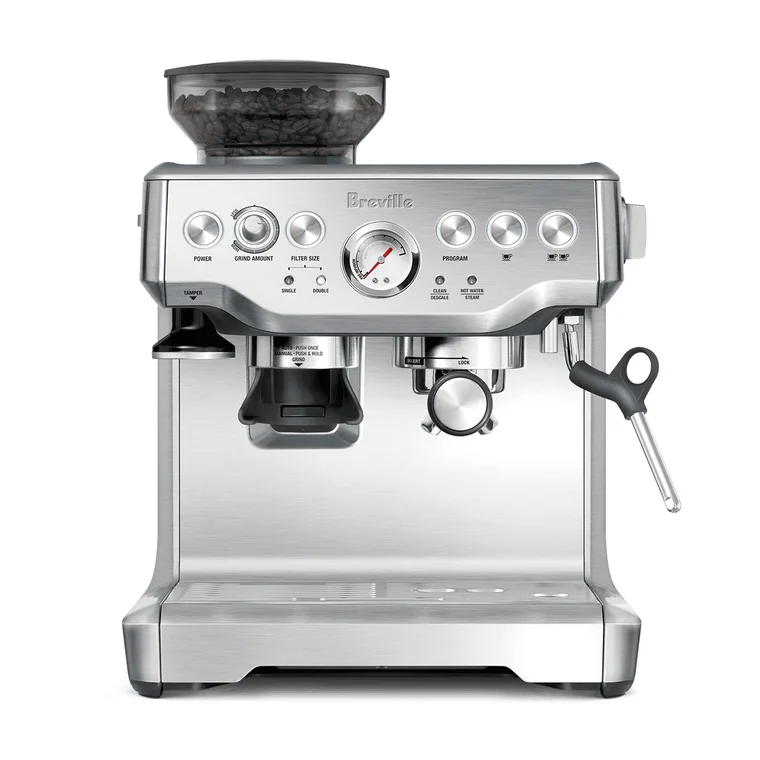
The easiest path to genuinely good espresso. A built-in grinder, a pressure gauge and a forgiving workflow in one stainless body for around $700. The single boiler means you wait between brew and steam, but for most beginners this is the one.
Check price at Breville →- Built-in conical burr grinder
- Pressure gauge guides your shots
- One footprint, one purchase
- Huge community and accessories
- Forgiving for new baristas
- Single boiler, wait between brew and steam
- 54mm portafilter, not 58mm commercial
- Some plastic parts at the price
- The grinder is good, not great
The Barista Express is the machine I recommend more than any other, and also the one I talk people out of more than any other. It packs a conical burr grinder, a 54mm portafilter, and a steam wand into one box for around $700, which is the closest thing to a "just buy this and start" answer in home espresso. The all-in-one promise hides a few tradeoffs that never make it into the product photos, though. I've owned one, dialed it in for friends, and pulled enough shots on it to know exactly where it shines and where it makes you wait.
How it actually pulls a shot
The built-in grinder is what makes the Barista Express worth its price. It is a conical burr grinder with 16 settings, and it grinds straight into the portafilter when you cradle it under the spout. That sounds minor until you understand how much grind drives the cup: a great machine fed by a bad grinder pulls bad shots every time, which is why dialing in the right espresso grind size matters more than any other variable. Putting a real burr grinder in the box saves you the $150 to $300 you would otherwise spend on a separate one, and it makes the whole thing feel like one tool instead of two.
Those 16 steps are also the catch. Espresso lives in a narrow band, and 16 settings are not always fine enough to land exactly where you want, especially with fresh, oily, dark roasts. You can compensate with dose and tamp, but you will occasionally wish for a click between two settings. Reach for the hidden internal adjustment, an upper burr you can reposition, and the grinder opens up to a much finer range. Most owners never touch it. You should.
Pulling the shot itself is satisfying. A 15-bar Italian pump and PID temperature control through a single ThermoCoil heating system keep brew water stable shot to shot. The pressure gauge on the front is the unsung hero. It tells you, in real time, whether your puck is choking the machine (needle buried in the high zone, grind too fine) or gushing through (needle barely moving, grind too coarse). That little dial is how a beginner learns to read espresso without guessing. Get the gauge to settle in the espresso range and your shots will follow.
One thing first-timers should know: the Barista Express ships with both pressurized (dual-wall) and standard (single-wall) baskets, and you should start on the pressurized ones so you are drinking espresso on day one, then graduate to the standard baskets as your grind gets consistent. Why the pressurized basket flatters a sloppy grind, and why the single-wall one raises your ceiling, is covered in what to look for in an espresso machine.
The 54mm portafilter and the steam wand
The Barista Express uses a 54mm portafilter, not the 58mm commercial size you will see on a Gaggia Classic Pro or a Rancilio Silvia. This matters less than the forums make it sound. 54mm is Breville's standard across this whole line, baskets and tampers are easy to find, and the puck pulls just fine. What you give up is the huge aftermarket of 58mm bottomless portafilters, precision baskets, and accessories. Want to mod and tinker for years? That limited ecosystem is a real ceiling. Want great coffee without a hobby? It is a non-issue.
Milk steaming is fully manual, and this is where new owners hit a wall. There is no auto-froth and no button that does it for you. You hold the pitcher, position the wand tip, and texture milk by ear and feel. Your first week, the foam will be either flat or full of big bubbles. By week two or three it clicks, and you start pouring microfoam that actually holds a shape. That learning curve is the point, because manual steaming is how you get cafe-quality milk, but the wand does ask something of you.
The limitation people miss until they live with it is the boiler. The single ThermoCoil heats for brewing or for steam, not both at once. So you pull your shot, the machine switches modes and takes a moment to come up to steam temperature, then you froth. With one or two drinks the pause is small. Pull four cappuccinos for guests and that brew-then-wait-then-steam rhythm gets tedious. This is the core tradeoff against the dual-boiler machines: you save a lot of money and counter space, and you pay for it in time when you make milk drinks back to back. A household pulling a couple of drinks a morning will barely notice. A small dinner party will.
Living with it: maintenance and reliability
At around 23 lbs with a 67 oz water tank, the Barista Express has presence on a counter without being a monster. Day to day upkeep is manageable. After each session you backflush the group with the blind disc Breville includes, wipe down the steam wand immediately (milk crust is the enemy), and empty the drip tray and puck bin. The machine flashes a cleaning reminder when it is time for a deeper backflush with cleaning tablets, and it nags you to descale on a schedule.
Descaling is the task people skip and regret. The single ThermoCoil is sensitive to scale buildup, and hard water will shorten its life if you ignore it. Run filtered or softer water from the start and run the descale cycle when prompted. After years of watching these machines, my read is that the brewing side is solid, and the most common failure points are scale-related or a grinder clogged by oily beans. Both are preventable with basic habits. Keep it clean, keep it descaled, and a Barista Express runs for years. For the full routine, our guide to descaling and maintenance walks through it, and how to use an espresso machine covers the daily flow.
One detail that adds up: the grinder lives inside the machine, so if it ever needs service you cannot just swap it like a standalone unit. That is the flip side of the all-in-one convenience. In practice it rarely comes up, but it is worth knowing before you buy.
Who it is for, and who should skip it
Picture the person who wants real, dial-it-in espresso, wants the grinder solved in the same purchase, and is willing to spend two or three weeks learning the steam wand. For that person, this is the most sensible $700 in home espresso, and it is exactly why the Barista Express is our standing pick on the best espresso machine with a grinder hub and a top call for newcomers on the best espresso machine for beginners list. The grinder, the gauge, and the forgiving baskets remove the three things that usually defeat first-timers.
Where does it stop making sense? If you mostly want one-touch lattes with no fuss, the manual wand and the dial-in process are precisely what a super-automatic exists to eliminate. When pushing a button for a cappuccino sounds better than learning to texture milk, look at a bean-to-cup machine like the De'Longhi Magnifica Evo instead, and read our take on semi-automatic vs super-automatic before you decide. You will trade control and outright espresso quality for convenience, which is the right call when convenience is the whole point.
The tinkerer who wants the 58mm aftermarket, simultaneous brew and steam, and room to grow for years should also look elsewhere. That person wants a bare semi-automatic plus a dedicated grinder, or a dual-boiler down the line. The Gaggia Classic Pro as a modding platform or the best prosumer espresso machine options make more sense for that path.
Barista Express vs Barista Pro
This is the comparison that stalls most buyers, so here is the short version. The Barista Pro is the step up at around $900, and it changes two real things. Heating comes first: the Pro swaps the ThermoCoil for ThermoJet, which reaches brew temperature in about 3 seconds versus the Express's longer warm-up. The grinder comes second: the Pro has 30 grind settings instead of 16, so you get finer control to land your dial-in. The Pro also has an LCD display instead of the analog pressure gauge.
| Spec | Barista Express (BES870) | Barista Pro (BES878) |
|---|---|---|
| Price | Around $700 | Around $900 |
| Heating | Single ThermoCoil | ThermoJet (about 3-second heat-up) |
| Grinder settings | 16 | 30 |
| Display | Analog pressure gauge | LCD display |
| Portafilter | 54mm | 54mm |
The faster heat-up is nice but not worth $200 on its own, because the Express is ready in a couple of minutes and you are usually doing other morning things anyway. The 30-step grinder is the more meaningful upgrade for someone chasing precision. Beyond those two changes, though, both machines pull the same caliber of shot once dialed in, both share the single-boiler brew-then-steam limitation, and the Express's pressure gauge is arguably a better teaching tool for a beginner than the Pro's screen. On a tight budget, the Express loses you nothing in the cup. If $200 is noise to you and you want the finer grinder and instant heat, the Pro is the small luxury. Our full Barista Express vs Barista Pro breakdown digs deeper, and the Barista Pro review covers the Pro on its own.
The bottom line
The Barista Express earns its reputation. It solves the grinder problem in the box, the pressure gauge teaches you to read your shots, and the forgiving baskets get you drinking espresso the first day while leaving room to grow into the real thing. The caveats are equally clear: a single boiler that makes you wait between brewing and steaming, a 54mm portafilter that limits the aftermarket, and a steam wand that takes a few weeks to master. None of those are dealbreakers for the home enthusiast it is built for. They are the price of an all-in-one that costs $700 instead of $1,600.
Want cafe-quality espresso, happy to learn a little technique, and drawn to the idea of one tool doing the whole job? This is the machine I would point you to first. You can check current pricing at Whole Latte Love or directly from Breville. And if you are still weighing the whole field, start with our best espresso machines overview or the guide on what to look for in an espresso machine before you commit.
Check current pricing and any bundle deals from a trusted espresso retailer. Prices move with sales.
Affiliate link. We may earn a commission at no extra cost to you. It never changes our rankings (see how we test). We pull real shots before we recommend a machine.
Frequently asked questions
Does the Breville Barista Express come with a grinder?
Yes, and it is the main reason to buy it. The Barista Express has a built-in conical burr grinder with 16 settings that grinds straight into the 54mm portafilter. Because grind quality drives espresso quality more than anything else, having a real burr grinder in the box saves you the cost of buying a separate one and makes the machine feel like a single complete tool.
Can the Barista Express brew and steam at the same time?
No. It uses a single ThermoCoil heating system, so it heats for brewing or for steam, but not both at once. You pull your shot, then the machine switches to steam mode and takes a moment to come up to temperature before you froth milk. For one or two drinks the pause is minor. For several milk drinks back to back, it gets tedious, which is the main reason people step up to a dual boiler.
Is the Barista Express good for beginners?
It is one of the best beginner machines. The built-in grinder removes a major hurdle, the front pressure gauge teaches you to read whether your grind is too fine or too coarse, and the included pressurized baskets let you make drinkable espresso on day one. The steam wand is fully manual and takes a couple of weeks to learn, but that is how you reach genuine cafe-quality milk.
Should I buy the Barista Express or the Barista Pro?
If budget matters, the Express at around $700 loses you nothing in the cup. The Pro at around $900 adds ThermoJet heating (about a 3-second warm-up) and a 30-setting grinder versus 16. The faster heat-up is convenient but not essential. The finer grinder is the more meaningful upgrade if you chase precision. Both pull the same quality shot once dialed in and share the single-boiler limitation.
How much maintenance does the Barista Express need?
Daily upkeep is simple: wipe the steam wand after each use, empty the drip tray and puck bin, and backflush with the blind disc. Periodically you run a deeper backflush with cleaning tablets and descale when the machine prompts you. Descaling matters most, since the single ThermoCoil is sensitive to scale. Use filtered water and keep up with descaling and the machine runs reliably for years.

I pulled shots behind a bar for years and now obsess over home espresso. I own and tear down these machines and write every review and guide here. I rank by what makes good coffee, not by who pays the most. How we test →